




The Influence of Corporal Punishment on Crime
The last legal flogging of a convicted felon in the United States occurred in Delaware in 1952. The barbaric practice was made illegal in that year, but Delaware waited until 1972 to formally remove the whipping post from the state penitentiary.
Flogging in the Navy for drunken or disorderly conduct was abolished in 1853. The Marines finally forbade all forms of physical punishment in 1957 after a drill sergeant led a disciplinary march into a bog where six young men were drowned. Military instructors now may not touch the person or the clothing of a recruit and "Any fracture, concussion, contusion or welt shall be considered prima facia evidence of excessive force." There are no exceptions made on the grounds that some young men bruise easily.
Slavery and involuntary servitude had always been maintained with the help of whips, but that disappeared in the United States with the Emancipation Proclamation issued by President Lincoln, January 1, 1863.
Spousal abuse used to be termed "reasonable chastisement of wives" and was presumed necessary to maintain the sanctity and stability of the family. All states now have laws against such assaults, and law enforcement and the courts have begun to take seriously, complaints of spousal battery.
Only Children
Now, in 1987, physical punishment is considered too severe for felons, murderers, criminals of all kinds and ages, including juvenile delinquents, too demeaning for soldiers, sailors, servants and spouses. But it remains legal and acceptable for children who are innocent of any crime.
The reasoning behind this curious discrepancy has been the belief that physical punishment will prevent the child from becoming a criminal. The frequent headlines: "Rising Tide of Juvenile Delinquency" usually attribute the situation to a decline of the use of corporal punishment in schools and homes. "Permissiveness," or letting the child do as he pleases, assumed by some to be the only alternative to hitting, is pervasively believed to be the primary cause of anti-social behavior. In the good old days, it is said, "old fashioned discipline" kept children in line. There was very little crime. Harmony reigned. Or did it?
The Truth About the "Good Old Days"
There are no reliable statistics on the extent of crime a hundred or a hundred and fifty years ago. From all reports, however, crime in the U.S. was extensive, especially violent crime and crimes among the young. The good citizens of 19th century America were also alarmed. They looked back to the good old days of simple rural life, before the growth of the cities. The crowded and crime-ridden Eastern cities were contrasted unfavorably with the "wide open spaces" of the West - the West, that is, of Jesse James and Billy the Kid!
Discipline in the one room schoolhouses was violent. Often the teacher engaged in a bare knuckle fight with the biggest student as a warning to the others of what would happen to them if they provoked his wrath. Horace Mann, the Father of American education, fulminated against the number of floggings per day, sometimes more than the number of scholars. Most of our great grandparents were satisfied with a fourth grade education and eighth grade was the end for all but five percent. The lawless mountain men of the Old West were recruited from the 14-year olds who high tailed it after one thrashing too many. Bands of outlaws stole horses, and plagued the defenseless. Public hangings and Iynchings were commonplace while pickpockets worked the crowds. Only the militia and the sheriff's posse maintained any semblance of order.
Yet the myth remains that only woodshed discipline in early youth keeps boys from a life of crime, and that respect for authority is promoted only by painful procedures that induce fear and resentment of authority.
What is the truth? Let's take a good hard look at the facts about the effects of corporal punishment on crime.
After Effects of Physical Punishment
Adrenalin output increases sharply during fear, anger and physical punishment. When this is prolonged or often repeated, the endocrine balance fails to return to baseline. The victim becomes easily angered and prone to poor impulse control and spontaneous violent outbursts.
Educational achievement is affected both directly and indirectly. Studies of prisoners, delinquents, school drop-outs, college freshmen and successful professionals are compared in the following composite report:
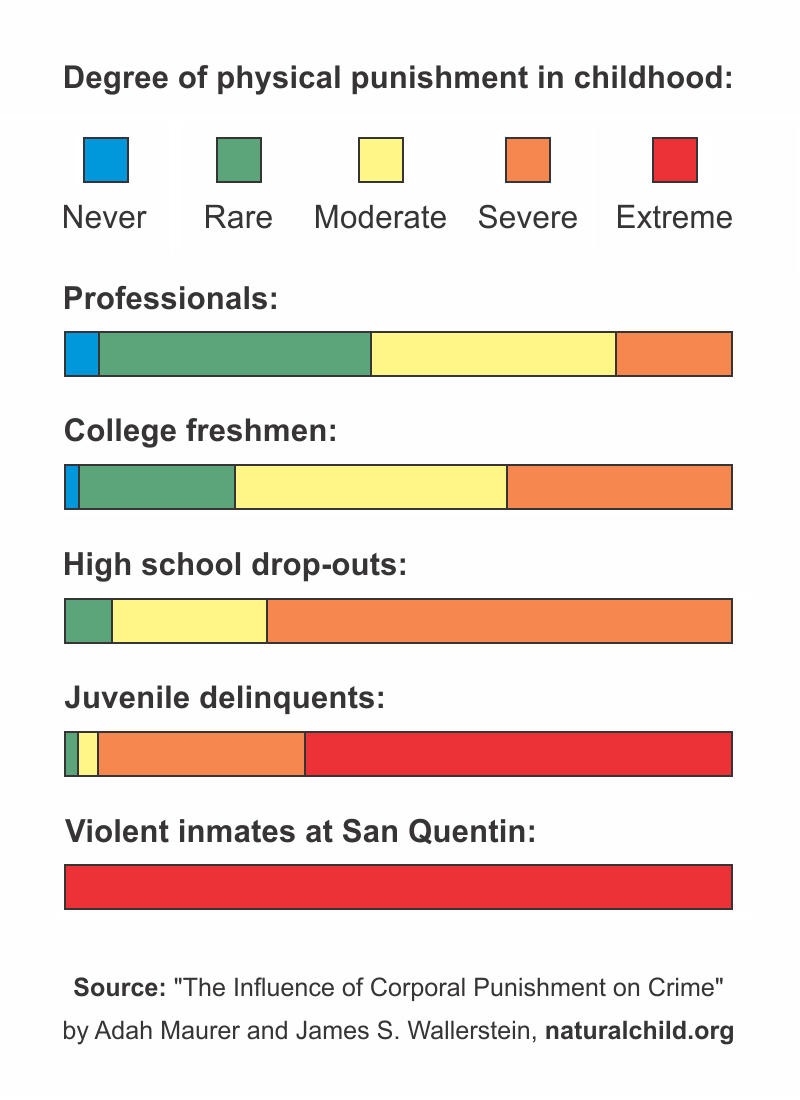
Taking part in this survey were: 200 psychologists who filled out anonymous questionnaires, 372 college students at the University of California, Davis and California State University at Fresno, 52 slow track underachievers at Richmond High School. Delinquents were interviewed by Dr. Ralph Welsh in Bridgeport, Connecticut and by Dr. Alan Button in Fresno, California. Prisoner information was by courtesy of Hobart Banks, M.S.W., counselor of difficult prisoners at San Quentin Penitentiary, San Quentin, California.
Timing
Do delinquents grow from lack of discipline? Or from too much discipline? Dr. Alan Button reports, "This, it now appears is the wrong question. We should be asking about sequence. Parents of delinquents, all of them, report physical beating in the first ten to twelve years of the child's life, but rarely thereafter. They "wash their hands" of the kid because "nothing works." Then the judge, finding that the boy has no supervision, denounces permissiveness.
The Belt Theory
Dr. Ralph Welsh who has given psychological examinations to over 2,000 delinquents, has developed what he calls. "The Belt Theory of Juvenile Delinquency." Dr. Welsh tells us:
"The recidivist male delinquent who has never been exposed to the belt, extension cord or fist at some time in his life is virtually non-existent. As the severity of corporal punishment in the delinquent's developmental history increases, so does the probability that he will engage in a violent act."
Driving Under the Influence
Car crashes caused by drunk driving are increased by a hidden factor. Bottled up anger, when combined with alcohol is the largest cause of the highway death toll which comes to 25,000 deaths every year, or one every 20 minutes. An investigation by Donald C. Pelz of the Institute for Social Research at the University of Michigan in 1973 led to his finding that: "For the young male, anger toward the adult world is likely to find vent in dangerous driving ... Hostility tends to multiply with their attitude toward the educational system ... Those who had rejected the school system ... are likely to reject the highway system. " In fact he concluded that abiding anger was even more dangerous than drinking per se, but that the combination was the most deadly. The insult to high school boys of an embarrassing paddling raises the adrenaline level, which if repeated often enough stays high all the time. They are the timebombs whose battlefield casualties litter the roads and intersections of our country.
Spanking the Baby
The effect begins early. Babies just over a year were observed with their mothers at a clinic at the University of Houston. As reported in Psychology Today interviews about the methods of discipline they used revealed that the babies who where punished physically were the least likely to obey instructions not to touch breakables. Even more importantly, seven months later the punished children lagged behind the others in developmental tests.
The Real Reason
Why, with all this evidence about the destructive effects of physically painful punishments, do so many people continue to believe that the only alternative to hitting children is to negligently allow them to do as they please? And that what they please is always delinquent, if not outright criminal?
At the National Center for the Study of Corporal Punishment at Temple University in Philadelphia a large research project inquired of adults the reasons for their beliefs, both pro- and anti-paddle. Most thought they had arrived at their belief logically, but in truth, the real determinant was their own childhood history. Those who had been spanked, paddled, switched, whipped etc. tended overwhelmingly to believed in it. Those who had not been hit, and had attended non-hitting schools, did not believe hitting did any good or were shocked and dismayed at the very idea. The action-language of our childhood overrides logic more often than not. Minds and habits do change, however, but it takes thoughtful assessment and considerable motivation even by people of goodwill.
Institutional Abuse
Whether the beatings were at the hands of the natural parents, or others who stood in for them seems to make little difference except that institutional punishments lack even intermittent moments of pride and belonging, that might in some cases mitigate slightly the worst effects. Charles Manson, the child of a 15 year old single mother had his first contact with police when he was 7 and spent the rest of his life in a series of foster homes, reform schools and prisons. He could have survived the rejection of his mother, he says, if reform school of officials hadn't been institutionally cruel, whipping, beating and raping him, and letting other inmates do the same.
A survey of 3,900 people in Houston as to what effect school corporal punishment had on their lives
found that 76 percent of them said the effects had been negative and that they continued to resent what
happened to them. That leaves about a fourth of them who were able to shrug it off and a mere handful
who felt grateful for the timely punishment that "saved me from a life of crime." Thus, the
one who testifies that "I was paddled when I was a kid and I turned out okay," must be labelled
a survivor and congratulated on the strength of character that enabled him to make a life in spite of
early mistreatment. Phychologist Robert Fathman, has offered this apt analogy: "Many people grew
up in homes that had outhouses and they turned out okay. But do outhouses get the credit?"
Editor's note: Since 1987, when this article was written, many countries have outlawed physical punishment of children. Unfortunately, as of 2021, it remains legal in the United States, Canada, The United Kingdom, Australia, and many other countries.